
In short
- T-Centralen is the main hub with famous blue vine motifs.
- Solna Centrum offers dramatic red and green cave walls.
- Stadion features a massive rainbow on a sky-blue ceiling.
In this article
Navigating the 110-kilometer network requires knowing exactly where to stop. By focusing on a few key stations across the Blue and Red lines, you can capture the best photos and experience the underground art gallery efficiently. You only need a standard SL ticket or travelcard to see them all.
Where is the famous blue and white cave station?
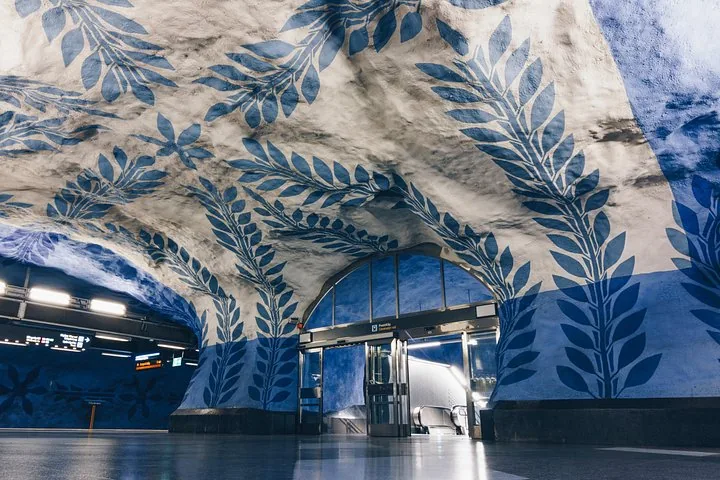
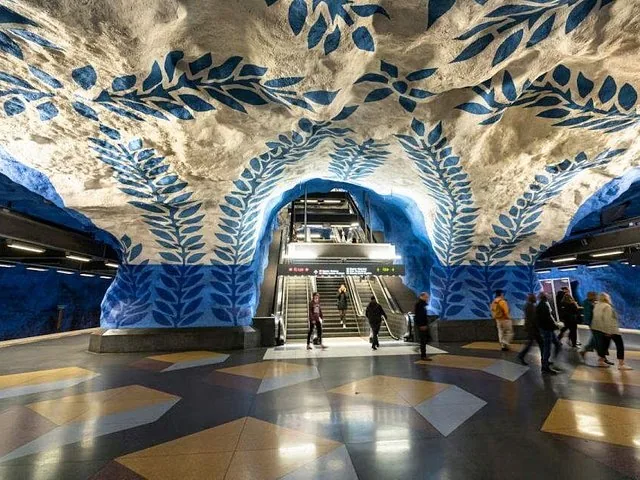
T-Centralen is the iconic blue and white station.
T-Centralen serves as the main interchange where all three metro lines converge. Head specifically to the Blue Line platform at the lowest level of the station. Here, you will find the famous blue vine and floral motifs painted directly onto the white cave walls by artist Per Olof Ultvedt.
Which station has the bright red ceiling?
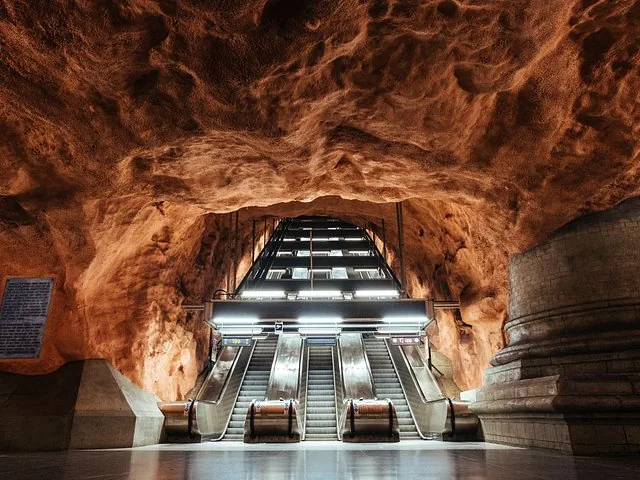
Solna Centrum is known for its intensely bright red cave ceiling.
Located on the Blue Line, Solna Centrum features dramatic red ceilings and green walls. The artwork depicts a 1,000-meter-long spruce forest. This stark, saturated contrast of red and green makes it one of the most striking locations for photography.
Where is the rainbow station in Stockholm?
Stadion station on the Red Line features a massive, vivid rainbow.
Stadion was designed to commemorate the 1912 Stockholm Olympics. The station boasts a bright rainbow painted across a sky-blue cave ceiling. Stand right beneath the rainbow arch in the center of the platform for a perfectly symmetrical photo.
Which stations have the best exposed bedrock architecture?
The Blue Line is famous for its dramatic exposed bedrock covered in sprayed concrete.
Alongside T-Centralen and Solna Centrum, Rådhuset and Kungsträdgården are excellent stops. Rådhuset is painted in a rich, earthy pinkish-brown tone, designed to look like an undiscovered grotto. Kungsträdgården is a subterranean garden painted in green, white, and red, featuring historic relics embedded in the concrete.
Are there interesting stations on the Green Line?
Yes, Hötorget and Thorildsplan offer unique designs on the Green Line.
Hötorget preserves its 1950s style with original teal tiles, contrasted by 1998 neon light installations on the ceiling. Thorildsplan is an outdoor platform decorated with pixelated tile art inspired by classic 8-bit video games like Pac-Man. Plan to visit Thorildsplan during daylight hours for the best visibility.
| Station | Line | Key Feature | Time Needed |
|---|---|---|---|
| T-Centralen | Blue Line | Blue vines on white cave walls | 20 mins |
| Solna Centrum | Blue Line | Red ceiling and green forest | 15 mins |
| Stadion | Red Line | Rainbow on sky-blue ceiling | 15 mins |
| Rådhuset | Blue Line | Pinkish-brown organic grotto | 10 mins |
| Hötorget | Green Line | 50s tiles with 90s neon | 15 mins |
How much time do I need for a self-guided tour?
A self-guided tour of the best stations takes 1 to 2 hours.
Most stations require 10 to 20 minutes to explore and photograph. A single adult ticket costs 43 SEK and is valid for 75 minutes of unlimited travel. If you plan to hop between many stations and take your time, a 24-hour adult travelcard for 180 SEK is highly recommended.
Questions travellers ask
How much does the Stockholm Metro cost?
A single adult ticket costs 43 SEK and is valid for 75 minutes. A 24-hour adult travelcard is available for 180 SEK. Discounted single fares for youth, students, and seniors are 26 SEK.
Does the Stockholm Metro run 24 hours?
No, the Stockholm Metro does not run 24 hours a day. Operating hours vary by line and day of the week, so check the SL app for current schedules.
Why is the Stockholm Metro called the world's longest art gallery?
It is called the world's longest art gallery because 94 out of the 100 stations feature unique artworks by 250 different artists across the 110-kilometer network.